Sunday, December 31, 2017

Nate Manzo's Dining Room to the Comfort Zone


By John Berry

There was a business that existed in the late 1940s (and maybe other businesses before) referred to as Manzo's Cocktail Bar. It was owned by Nate Manzo, who was born in 1898 and appears to have lived until 1968 from what I can tell. It was located at 17321 W. 6 Mile, or 17321 W. McNichols. A muffler location sat there recently. I don't know what Manzo's looked like in it's prime, but I bet it had a patio. From news accounts, it hosted a number of speeches and meetings for important people in town and meetings of businesspeople and other groups.


From the ad above, it appears that Manzo's Cocktail Bar entertained by using a Novachord, a relatively rare instrument made from 1939 - 1942. It appears that the Novachord is often considered to be the world's first commercial polyphonic synthesizer and only 200 or so were made. 

It appears that the Cocktail Bar eventually gave way to an Italian restaurant called Nate Manzo’s Dining Room as of May 1955.  It later served as the Apollo Cocktail Room in 1968 (apparently brief and would coincide with the passing of the owner). In 1972, the location was known as Jimi-Jons Lounge. A business known as L-Tech held the location from around 1992-1993. In 1997 through the early 2000s the location served as a jazz and music club called the Comfort Zone where a number of musicians played. 


Now, the location is an auto repair business, Best Hand Mufflers/Auto Repair but the property appears to be in the process of being sold according to realtor information on the Internet.


Wednesday, November 22, 2017

Olde Redford Bowl

By John Berry

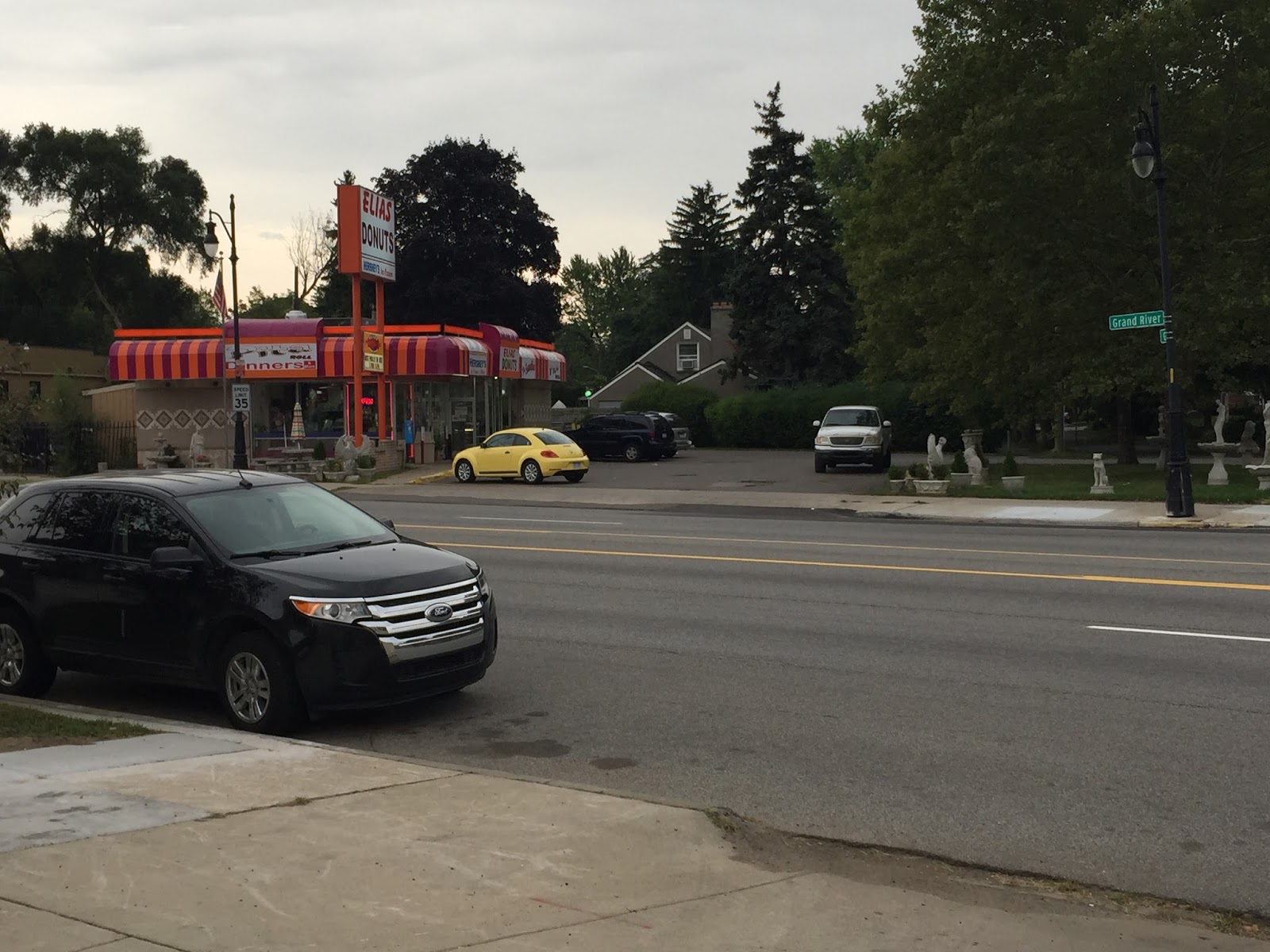
I remember Old Redford Bowl.  It was located at 22150 Grand River, not far from Lahser. My uncle used to take me here.  While it is not in Rosedale Park, but in Olde (Old) Redford, I thought I would post about it. My family used to take me there on occasion to bowl back in the early 1980s. The bowling alley building is still there but there is no longer bowling that takes place.

Old Redford Bowl - 2017

Old Redford Bowl was built in approximately 1927. The original name for the bowling alley was the "Redford Recreation Bowling Alley."  The bowling alley had 22 lanes and a cocktail lounge for “league” nights. I remember it as a very busy bowling alley.  In 1980, the bowling alley was renamed Old Redford Bowl as it was located in the Olde (Old) Redford area of town. Basically, it was located at Grand River and Lahser.

In 2001, there was a fire at Old Redford Bowl and it was temporarily closed for repairs, but would never re-open. As noted by the Detroitish website, "by 2010, scrappers, vandals, and vagrants began to destroy the former bowling alley."  This site has a number of great photos of the bowling area.  Old Redford Bowl still stands, however, it has been boarded up and is waiting for re-development.  Hopefully, somebody will invest the time and money to re-open this great bowling alley.

The building structure itself seems to be in relatively good shape, but the inside needs significant work.

Saturday, October 28, 2017

Stalehin's Nursery in Rosedale Park

By John Berry

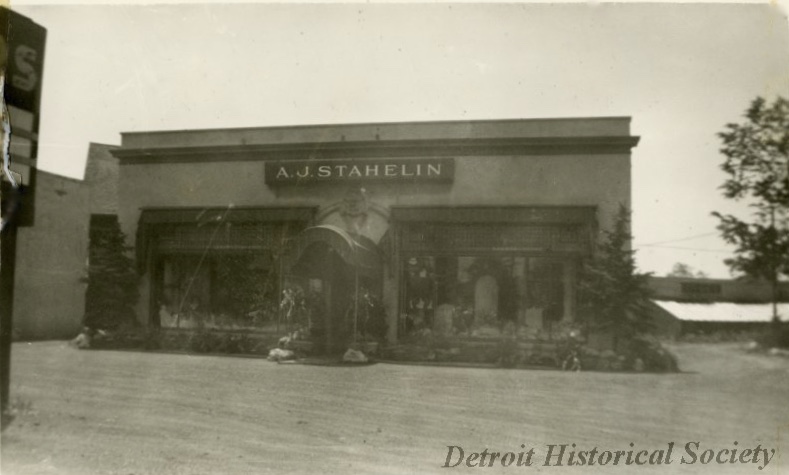
Stahelin Nursery - Credit Detroit Historical Society
Albert "A.J." Stahelin was born in March 9, 1878 in Detroit and lived until 1945, passing in Metro Detroit. He was an early fixture in Rosedale Park and Detroit area and a expert Florist.  He started Stahelin's Nursery in 1903 in Rosedale Park, following graduation from Michigan State University. As mentioned above, Mr. Stahelin was a very noted florist in the local Detroit area. His nursery lasted for over 50 years and past his death.  At some point, I can only surmise it was sold and torn down to build Grandland that occupied at least a part of this space.

Mr. Stahelin's original nursery was located at 18501 Grand River Avenue essentially where Grandland sits today, and in particular the Gamestop location.  If the Nursery was still located there, you could look out and see the CVS location across Grand River.

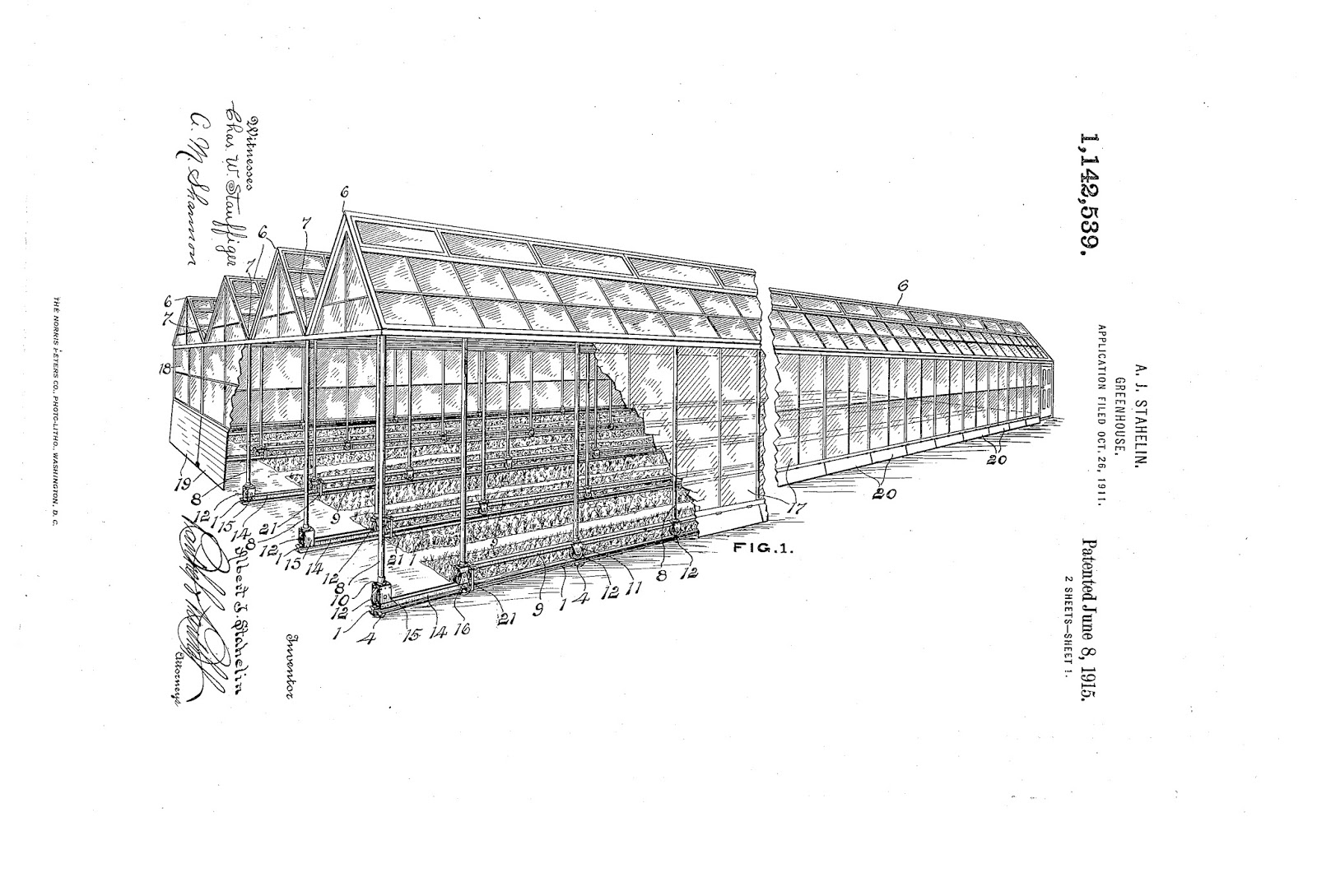
Copy of A.J. Stahelin Greenhouse Patent in 1911
Mr. Stahelin patented a greenhouse in 1911, which I believe was eventually built. The Greenhouse, according to another photograph from the Detroit Historical Society, still was present in about 1941 (also in another 2nd photograph). In 1920, the U.S. Census listed him as married to an Irene, 2 daughters, Betty and Albert and two servants and listed his profession as a florist. Several news articles list him as a prominent member of the Rosedale Park area.

As noted earlier, his nursery outlasted him.  He must have made a lasting impression on Rosedale Park and the entire Detroit area.  I am sure many of the readers must remember the business.  The last reference that I can find for the nursery is in the mid-1950s, which corresponds with the development, in the late 1950s/1960s of Grandland.  Any comments about the Nursery are welcome.


Wednesday, October 11, 2017

The Early History of Rosedale Park

By John Berry

Rosedale Park is a historic area in Detroit, Michigan. This article provides a bit of history on the birth of this historic Detroit area. When referring to Rosedale park, I generally consider it to include the areas of Grandmont, Rosedale Park and North Rosedale Park, although many consider parts of Old Redford part of this combined area (myself included). The Grandmont, Rosedale, North Rosedale area basically starts at Greenfield in Grandmont and reaches to Evergreen in North Rosedale Park and is also bounded by West McNichols (or Puritan in Grandmont) and Acacia.

Historical Sign Usually at the Beginning of Each Street
The land where Rosedale Park was built was first held by Otis C. Freeman and George Bellamy in the form of 2 separate multi-acre tracts. Mr. Freeman was deeded 80 acres of land in Northwest Detroit by President Andrew Jackson in October of 1835. These were likely tracts of vacant land and not part of Detroit at this time.  It appears that these were empty country fields given that there was not much between Detroit proper at the time and the City of Farmington at the time. Keep in mind that one of the few spots between Detroit and Farmington at the time was the Botsford Inn, founded in 1836.  Mr. Freeman's grant from President Jackson provided as follows below:

1835 Grant of 80 acres of Rosedale Park
In November of 1835, George Bellamy was also deeded 40 acres of land by President Jackson in the same area.  These properties would eventually be subdivided giving rise to the development that would occur in later years.

1835 Grant of 40 acres to George Bellamy
Prior to residential development, Rosedale Park was fairly rural. Eventually, in 1916, the Rosedale Land Development Company purchased these lands and developed a majority part of what would eventually become the Rosedale Park Historic District.  In 1916, builders, such as those listed below in this article, were marketing Rosedale Park as the place to be.  The comparison below describes the differences between the growth of Boston and Detroit, referred to as "Detroit the Dynamo."
1916 Article on Development of Rosedale Park
The slogan used in the development and selling of homes was "Out of the Smoke Zone and Into the Ozone." In 1917, the first residents of Rosedale Park, Mr. and Mrs. Barkley moved into the area. During World War I, there were about 15 families living in Rosedale Park. The houses continued to sell in Rosedale Park and the Firm of Clemons, Knight, Menard and Paul began to market the area to home buyers and builders.

1919 Rosedale Park Ad

According to a book by Bill Hudson and Jack Lillie, entitled A Quarter Century in North Rosedale Park 1 (North Rosedale Park Civic Association 1948), the first families of Rosedale Park were the "Herbert, Frank Day Smiths, Jake Judsons, Weavers, Art Sieberts, Cyril browner, Solars, Patricks, Nylands, Heibys and La Barres." In 1921, Rosedale Park was referenced as the Grosse Pointe of Grand River in advertisements.

The development of Rosedale Park continued on after this point and picked up.  During the World War I era, the area had rural mail delivery, well water and there were no streetlights. There was a nursery, called Stahelin's Nursery at 18501 Grand River Ave., where one day Grandland Shopping Center would eventually be built. It is hard to imagine that Grandland was essentially an empty field at that point.

Rosedale Park Today - 2017

Rosedale Park contains upscale brick houses which were mostly developed from the 1920s through the 1940s. As someone who grew up looking at these amazing houses, I always imagined the first owners to be extremely wealthy. The City of Detroit obviously felt the same way and annexed Rosedale Park in 1926, bringing water and sewer to the neighborhood and making the area more attractive to purchasers. Many of the original Rosedale Park homeowners were professionals, such as doctors, engineer, dentists, and accountants, or had white-collar jobs in the growing automobile industry.

The homes built encompassed a number of styles, such as English Tudor Revival, Arts and Crafts, Bungalow, New England Colonial, Colonial Revival, Dutch Colonial, American Foursquare, French Renaissance, Ranch, Cape Cod and others. There was a focus, somewhat, on English styles.


Friday, September 22, 2017

Rosedale Park 1917

An interesting article from the Detroit Free Press in November of 1917.  It is the real first mention of  the beginning of Rosedale Park that I can find.  

From the article:

Grand River at Mill Road and six other artistic houses nearing completion, of the following types:"

English Half- Timbered
Dutch Colonial
Modern English
New England Colonial
Attractive Stuccos (Western Design)

High class material and workmanship through as well as -- plate glass in all front windows -- pressed brick all around -- White brick in basements -- Slate roofs or stained cedar shingles -- Sun parlors -- Sleeping porches -- Steam heat -- Ash receivers under furnaces -- Kerner Incinerators -- Fireplaces with dome dampers.
. . .

Rosedale Park consists of 354 acres, and is being developed with 14 boulevards, 80 to 100 feet in width. Each boulevard will be paved and curbed with concrete, elaborately parked and beautified with lawns, flowers, shrubbery and shade trees. 

An artesian water systems - 30,000 gallon tank - fire plugs - 4, 6, 8-inch mains - is about completed.  A complete and permanent sewerage system. A boulevard lighting system - underground wiring - iron standards.  A beautiful grove of trees has been dedicated as a park for the neighborhood. Recreation grounds and school and church sites are reserved, besides the sidewalk and a shade tree which you usually get on a subdivision.

These homes are being built to establish a standard for the property and to serve as a nucleus for the community that will rapidly follow. Profit is a secondary consideration. Visit Rosedale Park and see something different. Inspect these homes and then let us tell you the prices and terms. The have prepared a booklet on Rosedale Park, illustrating some of these homes and explaining our plans and purposes.  It will be mailed at your request.  


Saturday, September 2, 2017

Intro to the Rosedale Park History Blog

By John Berry

Rosedale Park is an amazing area of Detroit, which I remember fondly from my childhood.  My mother's side were mostly born and grew up there.  I came along much later, but was essentially raised in my uncle's law office there in the late 1970s through the 1980s.  I love Rosedale Park at hope you will enjoy this blog and the Facebook page I made.

Memorial Day in the Rosedale Park Area

By John Berry As I think about Memorial Day, I wanted to call out a veteran who lost their life in the service of our country who came fro...